Banner AI generated.

Thursday, March 18, 2021

Houdini's LAST Australian flight was the wild one


Today marks the 111th anniversary of Houdini first successful flight in Australia on March 18, 1910. Certainly this was his most famous aviation exploit, and it's one that has been covered pretty thoroughly. So today I thought I would talk instead about Houdini's last flight in Australia on May 1, 1910. This was the flight that truly showcased his skills and nerve as a pioneer aviator, and may have been the greatest risk he ever took in a life full of risks!

Houdini completed several successful flights at Diggers Rest in Melbourne after his first historic flight on March 18. Some of these flights were captured on film. At the end of the month Houdini moved on to the Tivoli Theater in Sydney. He had his Voisin bi-plane trucked to the city where it was made ready for flight at Sydney's Rosehill racecourse (which is still there).

Houdini made several private flights at Rosehill. His first flight of 300 yards on April 18 constituted the first controlled airplane flight in New South Wales. Later that same day Houdini flew three quarters of a mile, but he came down hard he was thrown from the plane. Another hard landing broke a wheel.

News of Houdini's successful flights had reached the residents of Sydney who were eager to see Houdini fly for themselves. So during his final week in the city, Houdini advertised that he would give public exhibitions every day between the hours of 9 AM and 3 PM (conditions permitting). Bess and Houdini's assistants were tasked with providing tea and cakes for the crowds.


Bad luck set in. The weather would not cooperate, and even when conditions were right mechanical problems would shut down the day's attempt. At one point a tube supplying coolant to the Voison's cylinders slipped off and hot water scalded Houdini's mechanic Brassac on his shoulder and thigh. Later in the week two aviators named Kotta and Newman arrived at Rosehill with their own Australian made plane to compete with Houdini. But their chassis broke while wheeling it out onto the field. The April 27, 1910 Parramatta Cumberland Argus And Fruitgrowers Advocate captured a typical day's disappointment:

CHEAP TO TALK
There were several hundred people at Rosehill racecourse on Sunday morning when it was announced that Houdini would go aloft on his aeroplane. The charge for admission was a silver coin. The day was very calm, but there were ominous streaks in the clouds, indicating confused currents. At about 11 o'clock Houdini announced it was too windy to fly, and this statement was met by shouts of derision from those who had paid to see the performance. He again announced that an accident cost in repairs from £50 to £300, and there was also a risk of life, which he did not feel disposed to take. Still there was banter, and Houdini then remarked: "It is cheap to talk, but it has cost me £3000 to learn to fly, and I know what I am talking about." Then the crowd melted away, feeling rather disgusted.

Houdini closed at the Tivol on Saturday, April 30. The next day was the last he could fly before the plane needed to be dismantled and made ready for shipping back to England. Conditions were still not ideal, but Houdini climbed behind the wheel of his Voisin anyway. Newspapers recorded what happened next:

Kalgoorlie Miner, May 2, 1910.

It was a wild ride and a fitting end to Houdini's Australian adventure. It would also turn out to be his last flight ever. And who can blame him?

After he had left the country, an aviation journalist discussing Houdini's Australian flights in the Brisbane Queensland Country Life remarked:

I think Houdini is one of the pluckiest men I have ever seen. And one of the rashest! The things he was trying to do at Rosehill! It was a small area, there were fences everywhere, and a stiff wind blowing. It was trying to fly under conditions in which Latham, for instance, would never have allowed his pupils to try to get off the ground. How that man escaped breaking his neck I don't know! But he did one good flight. Give him a month and a decent open plain and he would make a splendid one.


Related:

Tuesday, March 16, 2021

Pittsburgh fire truck escape mystery


Having recently cracked the case of the Cleveland boxcar mystery photo, I thought I'd throw out another puzzling Houdini escape. This time it's not a photo, but a news account of Houdini performing a "series of escapes" on a city fire truck in Pittsburgh on March 4, 1925. Below is the vague but tantalizing account.

Pittsburgh Post Gazette, March 5, 1925

So what exactly did Houdini do here? "Straitjackets and handcuffs"? At the same time? Or did he do multiple escapes as the word "series" seems to suggest? Accounts leading up to the escape reported he would be atop "an 80-foot fire department ladder", but no mention of a ladder here.

For context, Houdini was performing his second week at the Davis Theater in Pittsburgh. This was his last vaudeville tour before he devoted himself to his full evening show in the fall.


What I'd most like to see are any photos from this mystery event. It would be especially exciting to see Houdini in manacles at this later age.

Here is the intersection of 5th and Smithfield streets today.


Top image is a 1925 American LaFrance fire truck from artebellum.com, which may or may not have been the type of fire truck Houdini used on this day.

Related:

Monday, March 15, 2021

Houdini at Gallica

Here's a photo of Houdini I've not seen before from the French archival website Gallica. It's a great candid shot that I would date as early 1920s (if taken in France, then it is 1920). Other than that I really don't know what's going on here with that string. But it sure has his attention!

Saturday, March 13, 2021

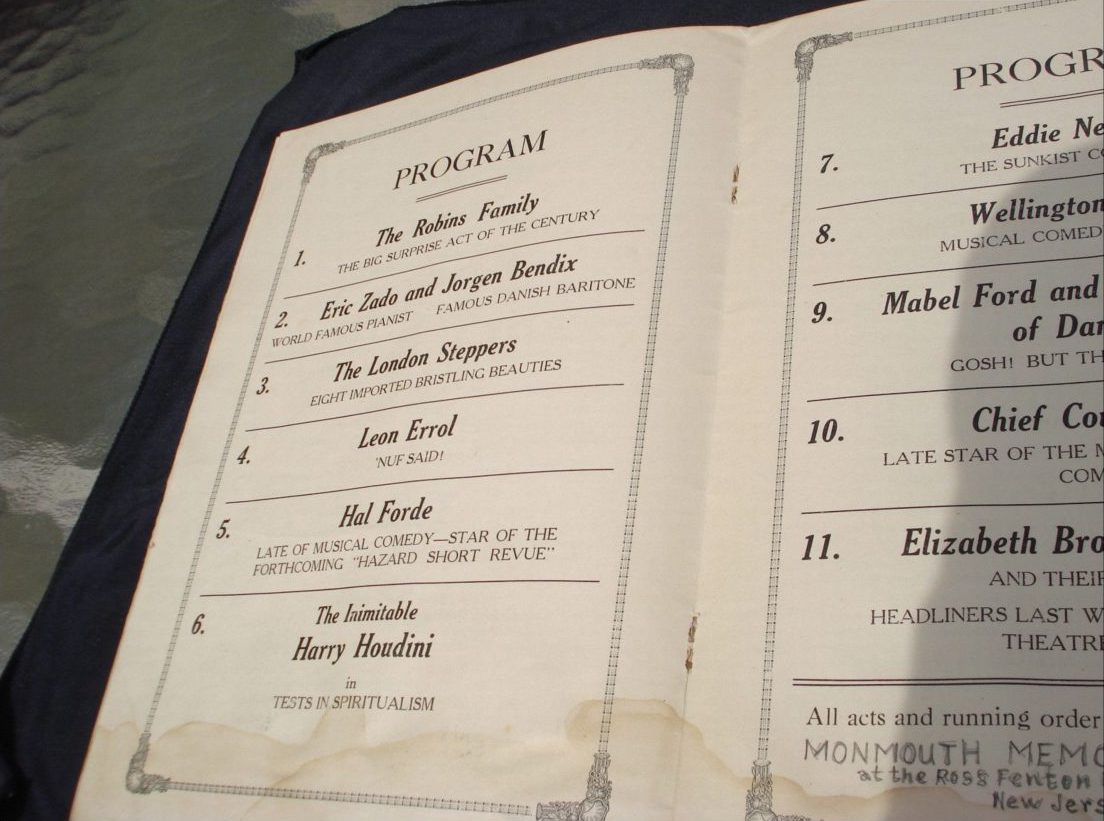
Houdini's Monmouth County mystery

John Barrows at This Day in Monmouth County History has written a terrific article about Houdini's known and possible appearances in Monmouth Country, New Jersey. I actually helped send him down one particular rabbit hole, which opens his piece:

On Monday, August 11, 1924, the legendary escape artist and entertainer Harry Houdini gave what may have been his one and only performance in Monmouth County.

Unless it never happened. 
Click to read:

An entry into my own Houdini chronology hangs in the balance, so if we can help John confirm or deny this appearance at Ross-Fenton Farm in Wannamassa, that would be great. Or find any other Houdini appearances in Monmouth Country.

Related:

Friday, March 12, 2021

Arthur Moses Presents Harry Houdini, Sunday

If you missed last month's Zoom conference with mega collector Arthur Moses, you'll have another chance this Sunday, March 14 at 7:00 PM (Central) via the Congregation Beth Israel.

Learn about Houdini's amazing life when CAS congregant Arthur Moses, renowned Houdini collector, bibliographer, lecturer, and archivist, presents a fascinating Zoom program. You will be treated to an exclusive personal video tour of Arthur's collection of more than 6,000 items of Houdini memorabilia. From straitjackets and handcuffs to photographs and rare posters, some of these items have been displayed at museums all over the US. 

Arthur will also gladly answer all your Houdini-related questions. 

Click here for the Zoom link and passcodes. Participation is limited to 100, but you can also watch the live stream via the Synagogue's Facebook page.

Related:

Wednesday, March 10, 2021

Homeowner discovers Houdini posters in her walls!

Here's an exciting one! A woman in Warwick, Rhode Island has discovered several original Houdini posters in the walls of her home during a bathroom remodel. The Houdini posters along with an assortment of other theatrical posters appear to have been used as insulation. Some were cut to form fit the wall spaces, but many survived complete. The house dates to 1925 and all the Houdini posters are all from his appearance at the Providence Opera House in Fall 1926.


The posters are window card size and are of two styles. One shows Houdini coming to Providence the week of September 20, but this actually didn't happen. Houdini remained in Boston for a third week and his Providence engagement was delayed until the week of October 4, which is what we see on the second style card. (This is a key historical detail that, IMO, confirms these as 100% authentic.)

As wild as this find seems, it has happened before. In 2006 a similar discovery was made in the walls of a home in Chicago and featured on the show The History Detectives. A window card similar to these sold at auction in 2019 for $2,200.

The lucky homeowner is weighing her options as to what to do with these, but she is open to private sales. If interested, she can be contacted HERE.

Tuesday, March 9, 2021

Hanco scoops Houdini (or perhaps Blackstone)


When Houdini toured Australia in 1910, he discovered the country was as jam-packed with rival "Handcuff Kings" as the U.S., UK, and Europe. In fact, part of his stage patter while in Australia was to inform his audiences that he was the originator of the feats they've been seeing other escapists perform for years.

One of the most active of those rivals was "Hanco The Handcuff King" (real name Sam Cooke). Hanco did handcuff, straitjacket, and challenge escapes, and also promoted his appearances with outdoor stunts. After Houdini left Melbourne for Sydney in April 1910, Hanco arrived in town and did a stunt at Queen's Bridge where Houdini had made a handcuffed dive just a few weeks earlier. But Hanco had his own approach. Check out the description below:

Ballarat Star, April 2, 1910.

Yes, that certainly sounds like an overboard box escape to me! And this is two years before Houdini's first overboard box in New York on July 7, 1912. Hanco also did a version of the escape on stage, which you can see advertised below.


Hanco did his overboard box in several Australian cities that year. But he seems to have had repeated difficulty getting his box--which may have been a commercial steamer trunk--to sink. And in Wagga Wagga he had another mishap.

The Wagga Wagga Advertiser, Feb. 24, 1910.

It's possible the issues Hanco had with staging the escape led to him abandoning it by mid year. After Houdini left the continent, Hanco began doing standard bridge jumps instead.

Houdini was certainly aware of Hanco. He posted some of Hanco's billing into his scrapbook of imitators. So there's little doubt Houdini would have been aware of Hanco and his overboard box escape during his 1910 tour. So is this were Houdini got the idea?

We've all heard the story of how Harry Blackstone Sr. said he originated the overboard box escape, a claim Houdini always disputed. I've tried my best to confirm Blackstone's story, but I've never found any newspaper clippings or photos of Blackstone doing the escape before Houdini. But now I'm thinking that argument is moot. From the evidence we have here, it appears both Harrys were beat to the box by Hanco The Handcuff King!

Thanks to Fred Pittella for the top photo which shows Hanco later in his career.

Related:

Monday, March 8, 2021

Guest Blog: Author-Lecturer-Mystifier-Mason

Recently I shared a link to an article about Houdini in the Jan-Feb 2021 Scottish Rite Journal, a magazine devoted to Freemasonry. The author, Maynard Edwards, got in touch, and explained that in the time it took to the publish that piece, he had continued his research and made several new discoveries and some corrections. So today I'm excited to share his updated article which rewrites what we know about Houdini the Mason. Enjoy.


Author-Lecturer-Mystifier-Mason
Recent Revelations in the Masonic Career of Brother Harry Houdini 
by Maynard Edwards, KCCH

On any list of famous Freemasons, Brother Harry (Houdini) is sure to be found. He was raised in St. Cecile Lodge #568 in New York on August 21,1924. St. Cecile Lodge was (and still is) a Daylight Lodge, geared specifically towards those in the performing arts, who often would not be able to attend evening meetings.

For at least the last thirty years, it has been reported that Harry became a Shriner shortly before his untimely death in 1926 and dates for his Scottish Rite Membership were not recorded publicly. However, a recent discovery at Mecca Shrine allows us to cement both his Scottish Rite and Shrine initiation dates much earlier than previously reported.

Mecca & The Mystifier

In March 2019, while cleaning up their office in the Grand Lodge of New York, Members of Mecca Shrine discovered a door hidden behind an old filing cabinet. The door led to a locker room and a curious discovery. The Current Assistant Rabban of Mecca Shrine in New York City, Noble Zachary Ostrow (right) explains "There was a big green locker that just had Mecca Shrine scribbled on the front of it. I don’t think anyone knew it had noticed it at least since the eighties. In there we found books full of Lodge records including petitions. The petitions were all numbered so we knew which ones were missing. After a few days of going through those books I found Houdini’s petition and it shows that he became a member in 1924. All the history books say 1926, and so people have gotten upset with me for finding this and making them have to re-write the history books."

The petition is signed by Houdini, and in his own handwriting he states his occupation as "Author – Lecturer - Mystifier". Conclusively we can now document that Harry Houdini became a Noble of Mecca Shrine on December 29th, 1924. Houdini became a Scottish Rite Mason in the Valley of New York Lodge of Perfection on October 7th 1924, joined the Council of Princes of Jerusalem on December 16th, and entered the Consistory on December 23rd.

Image courtesy Maynard Edwards.

Houdini was 50 years old when he became a Mason, but his experience in fraternal organizations began in 1903 when he became a member of the fledgling Society of American Magicians. The group had started only the year before with just 24 members in the back of a New York City magic shop. A rift with another prominent member of the club would cause Harry to resign in 1908, but by 1915 fences had been mended and Houdini was from then on an avid supporter of the group. He would be elected SAM President from 1917 until his death (interestingly, as President of S.A.M., Harry and other officers were referred to by the the title Most Illustrious).

When performing in a particular town, it was often Harry’s habit to connect with the local magicians and there are many surviving letters of his correspondence with fellow illusionists. It may have been such a connection that caused Harry to first mention an interest in Freemasonry.

My Dear Buckle

A postcard sent from Harry Houdini to a Mr. A. Buckle in 1904 was recently sold by the world famous Potter & Potter auction house in Chicago. The type written postcard, which sold for $900, reads:

My Dear Buckle,
Am very busy, have a very big task Tomorrow, and do not feell [sic] very much like writing. Regarding me being a Mason, I regret to inform you that I am not a Mason, and hope some day to belong to that Order. I do not belong to any secret order, and am a member of the S. of A. Magicians, and an Artist club in Germany.
Regards
Houdini.

The “A. Buckle” in this case was 20-year old Manchester Magician Arthur Buckle, sometimes billed as the Manchester Wizard. Buckle’s career consisted of mostly of private performances and writing for magical trade publications. The relationship between the then 30-year old Houdini and the younger conjurer isn’t well-documented, but it would not be a stretch to assume that as magicians they would have made each other’s professional acquaintance and become friends. The postcard salutation “My Dear Buckle” and another surviving letter from Houdini to Buckle indicate a personal relationship.

The postcard itself is remarkable for several reasons. First, the date of the postcard is March 16th, only a day before the famous Daily Mirror Handcuff Challenge, and the writing clearly indicates the challenge was on his mind. Also, Houdini expresses that he did not feel like writing. We know Houdini was troubled by an unknown illness during the end of his Hippodrome engagement and not long after the handcuff challenge, Harry was forced to take 12 days bed rest, canceling a number of engagements. Does this note indicate he was already feeling ill? Finally of course, it does seem to be the first documented expression of Houdini’s interest in Freemasonry.

While the postcard only reveals one side of the conversation between the two magicians, from it we can suppose that Arthur Buckle was a Mason and had asked if Houdini was a Mason, perhaps even inviting him to Lodge. In a collection of Houdini papers at the University of Texas in Austin, there exist other letters between Houdini and Buckle that may reveal more details, however as of this writing, those letters are not accessible due to the COVID-19 crisis.

Masonic & Magical Legacy

It would be another twenty years before Houdini’s interest in Freemasonry would manifest itself into his petitioning a lodge. Perhaps the business of being an international celebrity kept Houdini from joining the Brotherhood sooner rather than later? Or perhaps being elected President of the Society of American Magicians in 1917 increased his interest in fraternal organizations? We can only speculate as to why two decades elapsed before he was raised, his reasons are just one of the many secrets the Great Harry Houdini took to his grave.

There are no known photos of Harry in any Masonic garb, and his blue lodge petition, though not in question, has yet to be located. According to several Masonic sources, it is alleged that sometime after he became a Mason, Harry gave a benefit performance for for the Scottish Rite Valley of New York before a sold-out crowd of more than 4000 spectators at the Scottish Rite Cathedral (formerly the Manhattan Opera House, currently the Manhattan Center). However, no contemporary reports of this performance have been located, and no references to any such fundraiser has been found in any official Scottish Rite transaction. This leaves much doubt as to whether or not the performance truly occurred or perhaps was somehow conflated with another similar performance at some other time and place.

However, after his untimely death in 1926, Masonic funeral rites were performed by the Brothers of St. Cecile’s Lodge- which incidentally was held at the Elks clubhouse in New York (Harry became an Elk in 1912).

A great many vaudevillian performers were members of the Craft. Several of Harry’s Magical contemporaries were taken and accepted including Harry Kellar, Howard Thurston and even William Ellsworth Robinson- better known by his stage name Chung Ling Soo. As traveling performers, the Masonic Brotherhood would have provided vaudevillians with sort of safety-net while on the road. So too, the fraternity may have lent some of its dignity to a professional class that had historically been looked down upon.

Today the legacy of Houdini and the other Magical Masons of his era lives on in the Invisible Lodge, a Masonic club specifically for Master Masons who are either professional or amateur magicians. Founded in 1953 the club meets annually at midnight either at local Magician’s conventions or more recently at the Magic Castle in Hollywood. The Magic Castle itself is a private club for magicians and regularly members gather to hold a séance in an effort to contact the spirit of none other than Harry Houdini; so far the even the Great Houdini has not managed to reach back from the other side.

*Ill. Brent Morris, 33 and Jeff Croteau, Director of Library & Archives at the Scottish Rite Masonic Museum and Library in Lexington Massachusetts contributed to this article.

Related:

Sunday, March 7, 2021

More amazing AI brings Ehrich Weiss to life

I had planned on holding this back until Houdini's birthday. But I've decided to run with it today as the reaction to my first post featuring these AI animations by MyHeritage was so popular. (I also fear this viral sensation might be played out by March 24.) My approach has been to create animations that have no possible film equivalent. So below are three combined images showing the young Ehrich Weiss from ages 8 to 18. And this time in color!


Here's a bonus. Who is this stranger you ask? Well, let's just say if you are a fake medium you definitely don't want to see him in your seance chamber!


If you want to animate your own photos, MyHeritage offers a 14 day free trial.

UPDATE: I do know Houdini's eye color is wrong. His eyes should be blue. But I don't have any control over that. I just upload pics to the app and it makes it own color decisions unfortunately.

Thursday, March 4, 2021

"Don't do anything without declaring me in."

Here are a few treats to celebrate Hardeen's birthday today. Dash was born Ferenc Dezso Weisz on March 4, 1876 in Budapest, Hungary. But like his famous brother, he always claimed Appleton as his birthplace and adopted February 29 as his birthday (showing he had a sense of humor about all this).

Let's start with one of my all time favorite posters for either brother. If Houdini ever created a poster depicting a bridge jump, I've not see it. But it would be tough to do better than this one. This appeared on the back of the July 1945 Conjurers Magazine "Hardeen Memorial Issue". How I would love to see this in its original color.


Next is a terrific trade ad from the July 7, 1907 issue of Variety announcing Hardeen's return to America. There's a lot to love here, including a nice mention of trailblazing agent Jenie Jacobs. But I especially enjoy those lines at the bottom.

Click to enlarge.

Finally, I couldn't resist running Hardeen through the MyHeritage AI app which is all the rage at the moment. What little film of Hardeen that exists comes from much later in his life, so here we see him come to life in his early Handcuff Kings days.


Happy birthday Dash!

Wednesday, March 3, 2021

AI brings Houdini photos to life and it's wild!

I'm sure many of you have seen the latest viral sensation from MyHeritage that uses AI to animate old photographs in a way that is positively haunting. Of course, I had to run Houdini through this and the results are...positively haunting! This is a photo from my own collection. Witness the 20-year-old Houdini come to life.


I also couldn't resist seeing Houdini's parents in motion, especially as there is no known film footage of them. If only Houdini could see this.


If you're not freaked out enough already, here's one more I couldn't resist. Houdini's ectoplasmic face mask come to life. Believe.


If you want to animate your own photos, MyHeritage offers a 14 day free trial. You can also enhance and colorize photos in a way that is pretty impressive.

UPDATE: I couldn't resist going younger and color! Check out: More amazing AI brings Ehrich Weiss to life.

Tuesday, March 2, 2021

'Houdini and Me' by Dan Gutman released today

Today sees the release of Houdini and Me by award-winning children's author Dan Gutman.

Harry has always admired the famous escape artist Houdini. And when Houdini asks for help in coming back to life, it seems like an amazing chance...or could it be Houdini's greatest trick of all? 

Eleven-year-old Harry Mancini is NOT Harry Houdini--the famous escape artist who died in 1926. But Harry DOES live in Houdini's old New York City home, and he definitely knows everything there is to know about Houdini's life. What is he supposed to do, then, when someone starts texting him claiming that they're Houdini, communicating from beyond the grave? Respond, of course. 

It's hard for Harry to believe that Houdini is really contacting him, but this Houdini texts the secrets to all of the escape tricks the dead Houdini used to do. What's more, Houdini's offering Harry a chance to go back in time and experience it for himself. Should Harry ignore what must be a hoax? Or should he give it a try and take Houdini up on this death-defying offer? 

This is actually Gutman's second time using Houdini in one of his works. Houdini appears in his 2012 book Ray & Me which features a similar time-travel premise.

Below is a fun promotional video from publisher Holiday House featuring the author in New York.
 

Purchase Houdini and Me by Dan Gutman at Amazon.com and Amazon.co.uk.

Monday, March 1, 2021

'Houdini: The Elusive American' audiobook released

An unabridged CD audiobook of Adam Begley's Houdini: The Elusive American is released today by Tantor and Blackstone Publishing. It is read by Barry Adams.

Published in March of last year, Houdini: The Elusive American is part of the Jewish Lives series and is a solid and scholarly Houdini biography.

Purchase the audiobook at Amazon.com.

February 2021 in review

Here's a rundown of posts by category that appeared on WILD ABOUT HARRY in February. 

Most Viewed Post

Houdini History

Events


Other

Translate