Saturday, February 2, 2019

This is Houdini on October 14, 1926

We are all familiar with these photos of Houdini giving a radio address. To my knowledge, the location and date has never been identified. But while browsing the New York Heritage Digital Collections, I discovered these high res versions with full identification, and it's kind of a big deal!

This is Houdini doing a radio broadcast at WGY in Schenectady, New York, on October 14, 1926. You'll even note "WGY" in the right corner, which has always been cropped out of printed versions. This is a mere 17 days before his death. That suddenly puts these images in the running as being the last photos of Houdini.


This was the middle of a split week for Houdini. He has just completed a four day engagement at the Capitol Theater in Albany, where he had broken his ankle in the Water Torture Cell (so we can assume he's wearing a splint under the table). October 14 was the first of three days at the Van Curler Theater in Schenectady. He was then off to Montreal and his encounter with J. Gordon Whitehead, which would occur just 8 days after these photos were taken.

The current generally accepted "last photo" of Houdini appears on page 179 of NOTES to Houdini!!! by Ken Silverman. It shows Houdini flagging the start of an auto race in Worcester, MA. But he was in Worcester a full two weeks before these photos. There's also this recent candidate, but unless this turns out to be Montreal instead of New York (as it's credited), these Schenectady photos beat that as well.

So what do we think? With all our searching and obsessing on what could be Houdini's last photo, has it been right in front of our eyes this whole time?

The publisher of these images is miSci - Museum of Innovation and Science and are used here for educational purposes.

UPDATE: Here's something I just came across. In the February 23, 1942 issue of Broadcasting, WGY took out this full page ad celebrating 20 years in business. Spot a familiar photo here?

Click to enlarge.

Related:

Friday, February 1, 2019

WILD ABOUT HARRY January 2019 in review

I'm always concerned that the volume and speed of posts here on WILD ABOUT HARRY causes people to miss something they might have otherwise enjoyed. I post (almost) daily, but I certainly can't expect people to visit daily. So here's a rundown of posts by category that I've shared during this first month of 2019. As you can see, we're off to a WILD year!

Most Viewed Post
Holy smokes! Thirty minutes of largely unseen Houdini film surfaces

Houdini History
Houdini in 1919
Houdini hangs at the Palace
Bill Rauscher on Arthur Ford and the Houdini Code
Hanging with Houdini
A gift between Circumnavigators
A new photo from Hardeen's Medium Well Done
Houdini's Berlin bridge jump footage described
Was Houdini a chauvinist?
Bess leaves the act in 1908
Houdini arrives in Los Angeles
Here's Houdini's rarely seen aviation trophy today
Houdini said he first did Buried Alive in 1908
The Landrah Corporation?

Houdini's Last Secrets
Houdini's Last Secrets premieres tonight
No, that's NOT the secret of Houdini's Water Torture Cell (review)
Houdini's Last Secrets available for purchase online
Houdini's Last Secrets episode 2 hits the mark (review)
Facebook Live chat with George Hardeen today
George Hardeen talks Houdini and television
Houdini's Last Secrets episode 3 unlocks the Carette (review)
Houdini's Last Secrets episode 4 unearths Buried Alive (review)
Houdini's Last Secrets airs in the UK starting Feb. 6

Media
"Howlin' from the Houdini Hole" in Austin, Jan. 19
Wait, Houdini is in Holmes & Watson???
Listen to me on Dark Sun Rising tonight at 10 EST
Minerva vs. Houdini in new play
Prince Ea on Houdini and the prison of the mind

Books
Joe Posnanski has finished his Houdini book

Exhibitions
Houdini plays Atlanta in 1912...and 2019!
Jewish Museum of Maryland's farewell to Houdini

Mystifier File
Mystifier, First Quarter 1996

Auctions
What's wrong with this picture?
There's a skilled Houdini forger out there

Links
LINK: Houdini’s great-nephew seeks secrets to the magic in new TV show
LINK: Unknown Houdini Illusion for the 1927 tour
LINK: How Harry Houdini might have pulled off his most daring trick

Other
4000 posts
Houdini's Last Secrets Episode Guide (new page)

If people like this idea of a monthly review post, let me know in the Comments and I will make it a regular feature.

Thursday, January 31, 2019

The Landrah Corporation?

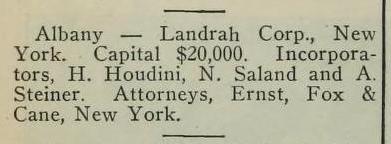
Here's a mystery for the end of the month. This appeared in the November 12, 1924 issue of The Film Daily and shows Houdini formed something called the "Landrah Corporation" that year. I have no idea what this was!


The only other reference I can find is a similar incorporation notice in the October 29, 1924 issue of Variety. This one is harder to read, but it does give a touch more information, including that the business is related to "pictures."


By 1924 Houdini was putting movies behind him, so it seems odd for him to be starting any new "picture" enterprise. Or maybe this has something to do with the dissolution of his various movie companies?

This is as deep as I've gone, so I figured I'd throw it out to the research wolves. Another Houdini mystery to chew on!

Related:

Wednesday, January 30, 2019

Houdini's Last Secrets airs in the UK starting Feb. 6

The 4-part series Houdini's Last Secrets will air on the Discovery Channel in the UK starting next Wednesday, February 6, 2019. Discovery can be found on Sky 125, Virgin 250, and BT TV 322.


The series, which just completed airing in the U.S., investigates Houdini's Water Torture Cell, Bullet Catch, Carette escape, and Buried Alive.

Thanks to Allan Taylor (who can be seen in episode 3) for the alert.

Related:

Tuesday, January 29, 2019

Houdini said he first did Buried Alive in 1908


On February 23, Potter & Potter will auction the first part of The Magic Collection of Jim Rawlins. Jim is a very nice guy who has a formidable collection, including some very nice Houdini items. Jim recently shared selections from his collection in two videos on his YouTube channel.

While I encourage you to watch both videos in full, what will be of special interest to Houdini nuts is what Jim shares at 15:30 in the below video. It's a signed copy of Miracle Mongers and Their Methods in which Houdini states he first performed the Buried Alive in Berlin in 1908! [Jim also blogged about this last year.]


I'm always leery of accepting any date from Houdini, especially when written from a distance (this was written in May 1926). However, 1908 makes sense as Houdini spent two months at the Circus Busch in Berlin. Saying that he rebuilt the apparatus in 1916 gives me some pause as it seems logical the rebuild would have happened in conjunction with the poster he had made in 1914. But I don't think we have any reason to doubt Houdini here. He performed the Buried Alive much earlier than anyone thought.

Houdini saying that he still has the apparatus changes how I think we should perceive his 1926 Buried Alive. Far from being a "new" effect developed for his new season, it appears it was an old effect he was dusting off. This is likely because the publicity windfall he received for the Shelton Pool Test suddenly made adding Buried Alive to the 3 Shows In One a great idea. In fact, you can almost imagine him getting that idea right after he writes this inscription.

This find also illustrates something I've been thinking about lately. Houdini's performances in Germany are a historical blind spot. Houdini spent a lot of time in Germany, and his engagements would last for months in a single theater. This gave him time to build apparatus and try out new ideas. But we know almost nothing about these German performances, probably because the newspaper accounts and playbills are all in German! But here's an indication of what we've been missing.

This particular book is not part of this first Potter auction of Jim's collection. For more information and to view the catalog visit Potter & Potter Auctions. Jim also sells items direct at his website Magic Collectibles.

Thanks to Joe Fox for this tip.

Related:

Monday, January 28, 2019

Houdini's Last Secrets ep. 4 unearths Buried Alive


Houdini's Last Secrets goes out on a positive note with an investigation of Buried Alive. This was a good choice of subject for the final episode. Apart from two posters, very little is known about this feat, so it was not only interesting to see how Houdini might have accomplished the escape, but it was interesting just to see how he might have presented it in the first place!

One can easily get buried in the history of Buried Alive as there were multiple versions. The show does a nice job of separating Houdini ill-fated outside buried alive stunt and his later stage-bound version. (They avoid the Shelton Pool Test.) The episode sticks with the conventional wisdom that Houdini never performed his stage-bound version. But in recent years, evidence has surfaced that shows he actually did perform it at least twice at the start of his 1926-27 season.

Interviews are again a highlight. This time George Hardeen visits Antony Britton in England, who attempted the outdoor casket-free buried alive and, like Houdini, nearly died. Roger Dryer shows us his magnificent Houdini Museum of New York which holds a casket Houdini escaped from in 1907 (unburied). It's a treat to see David Merlini and his own House of Houdini museum in Budapest, Hungary. I don't believe David has appeared in a Houdini documentary before, but his knowledge of Houdini history and his first hand experience with escapes--including being buried alive--make him an ideal interview subject. Finally, we get to see the mighty Arthur Moses in his own temple of Houdiniana in Fort Worth. Arthur handles his Houdini history with great authority.

In fact, this episode is probably the best yet as far as Houdini history is concerned, expanding it with mentions of his movie career and crusade against fraudulent spirit mediums. The idea that George is uncovering the story of his great uncle for himself and the audience is best realized in this episode. Of course, it wouldn't be "reality" TV without talk of a murder conspiracy! But the episode doesn't go too deeply into this and is not significantly derailed by it.

But the meat of the episode is the Buried Alive itself. Steve Wolf at Stunt Ranch constructs a theoretical version of Houdini's stage apparatus for magician Lee Terbosic to attempt. Both the conception and method is ingenious, and because we don't even know exactly how Houdini presented it, there's no danger of exposure. But in bringing the escape to life, one can appreciate how it was an effective stunt, and maybe even a lost Houdini masterpiece. So the episode has provided a real service to Houdini history by showing us what may have been.


Overall, this series turned out to be a mixed bag. It contained a disappointing amount of speculative hokum about Houdini being a spy at the expense of a more fact based exploration of his life. But the team's investigations and recreations of Houdini's feats were all very well done, and the series provided great interviews with fresh faces. And above all, it was respectful to Houdini and made him ever more fascinating!

It also did not turn out to be an exposure show as many had feared. They did indeed successfully ride the line between exposure and investigation, and in the case of a few genuine secrets, such as the Water Torture Cell, they went out of their way to protect the real method. So I'd say this series was a cut above and a worthy addition to the growing list of Houdini documentaries. I would be happy to see a second season.

The complete Season One of Houdini's Last Secrets is available for purchase at Amazon and iTunes.

If you're interested in more information on Buried Alive, check out the below links:

    Sunday, January 27, 2019

    LINK: How Harry Houdini might have pulled off his most daring trick

    This is a bit of a spoiler for tonight's fourth and final episode of Houdini's Last Secrets, but it's a good article by Mental Floss (an excellent website) with some nice details about the team's Buried Alive build. Click the headline to have a read.

    Stunt expert Steve Wolf considers the buried alive illusion Houdini's most daring trick. "The margin for failure on that is zero," Wolf tells Mental Floss.

    Houdini's Last Secrets airs on the Science Channel and the SciGO app. You can also stream episodes at their website or purchase the series at Amazon and iTunes.

    I'll share my review of episode 4 tomorrow.

    Related:

    Saturday, January 26, 2019

    Here's Houdini's rarely seen aviation trophy today

    Last Sunday I had the great pleasure of spending the morning with Eric Colleary who curates the Houdini Collections (and more) at the Harry Ransom Center at the University of Texas at Austin. Eric and his team recently spent two years cataloging their massive Houdini holdings, making many discoveries in the process.

    While returning from brunch at The Magic Castle, Eric mentioned that the Center has an aviation award that Houdini received. I instantly thought of the photo in Houdini's pitchbook of the trophy he received from The Aerial League of Australia for being the first man to fly on that continent (right). I've never seen this trophy outside of that one photo, and I've always believed it to be a lost piece of Houdini memorabilia, so this was exciting! But Eric said theirs was not a standup trophy, it was a wall hanging plaque, and that it mentions the Wright Bros. (?) So it didn't sound like we were talking about the same thing. But I was still intrigued to know what this could be, and so was Eric.

    So before we said goodbye, we both pulled out our phones and started searching. I brought up the familiar pic from the pitchbook while Eric pulled up a photo from their database.

    And my jaw hit the floor!


    This is indeed Houdini's Australian Aviation Award, which is not so lost and quite different from what I've always thought it to be. As you can see, it's not a standup trophy as the pitchbook photo makes it appear. What's even more interesting is Houdini appears to have mounted it inside a frame with a label noting that "In the Competition to win this Trophy HOUDINI had to defeat a Wright Bros. Flier & Bleriot Monoplane."

    I believe this was used as part of a theater display as the typography on the label matches others I have seen (notably in a photo of a Houdini window display in Silverman, credited to the Ransom Center). It's also interesting that Houdini felt the need to enhance his accomplishment by making it clear that he had beat others for the prize.

    Making this discovery was a great way to end our morning. I told Eric if we could accomplish this sitting in my car in Los Angeles, just imagine the damage we could do at the Ransom Center itself! We're both hoping that day will come sooner than later.


    Thank you to Eric and the Harry Ransom Center for letting me share this photo of Houdini's rarely seen Australian Aviation Award. The Houdini Collections are open to the public and available via finding aids at the Ransom Center website.

    Related:

    Friday, January 25, 2019

    Houdini arrives in Los Angeles

    Arthur Moses sends over this gem of photo that I've never seen before. This shows Houdini arriving in Los Angeles on April 20, 1919 to begin work on The Grim Game.


    This comes from the Exhibitors Trade Review, May 17, 1919, which also contains the following report.

    Houdini in California 
    Harry Houdini, monarch of mystery, has arrived in Hollywood, CAL., where he started work immediately at the Lasky studio under the direction of Irvin Willat in the big six-reel mystery picture written specially for him by Arthur B. Reeve, author of the "Craig Kennedy" stories, and John Grey. 
    Houdini was met at the Santa Fe station in Los Angeles by Studio Manager Fred Kley and others, including a number of newspaper and publicity men who had been lying in wait for him with a number of stunts of extrication which they figured he would be unable to perform. They wasted no time in setting the famous escape artist to work, but he managed to wriggle out of every single one of the schemes they had prepared for him.

    What I especially like is this tells us the train station where Houdini arrived. The Santa Fe station (or La Grande Station) was located on 2nd Avenue and Santa Fe and was the main passenger terminal in Los Angeles before Union Station opened in 1939. It was demolished in 1946.


    Thank you Arthur.

    Related:

    Joe Posnanski has finished his Houdini book

    Joe Posnanski has officially completed his Houdini book. Joe shared the news today on Twitter.


    You can pre-order The Life and Afterlife of Harry Houdini at Amazon.com and Amazon.co.uk. This promises to be the Houdini book event of 2019.

    Related:

    Thursday, January 24, 2019

    Prince Ea on Houdini and the prison of the mind

    Here's a well done motivational meme by spoken word artist Prince Ea that uses Houdini as a way to illustrate the hazard of "overthinking" a situation. In the clip reenactments, Houdini is played by Andrew Morrison.


    Ea adds some embellishments, such as locating this in the South and saying a condition of Houdini's jail breaks was that he had be dressed in his street clothes. But that is not correct. Houdini would famously allow himself to be strip searched and do his jail escapes in the nude, as he would have been here.

    So did this really happen? That's not clear. This is a story Houdini would tell himself, but he located it in the UK, not the American south. He also sometimes changed the context to a safe instead of a jail cell. So, like Ea, it appears Houdini might have used the story of the lock that was never locked as a parable. I do like how the video subtly implies that the jailer purposely left the door unlocked, perhaps to deliver the boastful Houdini this important life lesson.

    As to the message itself... In general, I'm not a fan of motivation speaking and its tendency to eschew practical advice in favor of magical thinking. The fact is 99% of the doors Houdini encountered were locked, and he opened those with hard work and study. "My brain is the key that sets me free," he was fond of saying.

    However, as I watched this, I remembered a clipping from the April 11, 1924 Asbury Park Press, which suggests Houdini did share a belief in the power of thought, so...


    Below are a few more links to Houdini-themed motivational works.

    Related:

    Wednesday, January 23, 2019

    Bess leaves the act in 1908

    Today is Bess Houdini's birthday. She was born January 23, 1876 in Brooklyn, New York. For the occasion, I thought I'd share a piece of information I only recently discovered. I've always wondered when Bess officially left the act. This clipping from the June 13, 1908 issue of Variety finally provided the answer.

    Variety June 13, 1908

    Bess made a brief comeback in 1914 doing Metamorphosis in the short-lived Grand Magical Revue. Houdini wrote in his diary that she was "magnificent" and "working as though she never retired." Bess would then periodically return to assist her husband on special occasions, such as a 1922 S.A.M. banquet attended by Sir Arthur Conan Doyle where the Houdinis used his coat during Metamorphosis.

    In 1925, Bess returned and became a full-time part of Houdini's 3 Shows in One. In fact, she was so much a part of the show, she even had her own poster.


    Happy birthday Bess!

    Related:

    Tuesday, January 22, 2019

    Was Houdini a chauvinist?

    In the new play, Minerva–Queen of the Handcuffs, Houdini, played by Richard Lee Hsi (right), is portrayed as the villain; representative of the chauvinistic attitudes toward women at the time. Playwright Ron Pearson says: "It gave me an opportunity to cast him as the symbol for all of the barriers and inequality that women had to endure at the turn of the twentieth century, particularly female performers."

    The play has received positive reviews, and I think Minerva is an inspired choice of subject and a great symbol for the ongoing struggle for women's equality in all fields. But is it fair to characterize the real Houdini as an impediment in this struggle?

    Houdini was a man of his time and I think we can assume he possessed a certain level of male chauvinism that was endemic in society. And there was the crack he made at the male only Circumnavigators Club that he gave up aviation "when women took it up." So he's not without fault.

    But Houdini also worked alongside women his entire career. Vaudeville had as many female performers as male. And remember that Bess was an equal part of the act for many years. In fact, it was Bess who suggested they change the name from "The Houdinis" to just "Houdini" because she felt they'd do better. And far from being aghast at the idea of a female escape artist, in reality, Houdini backed his own, Miss Trixy (Wanda Timm). Of course, this was done to undermine another female escapist, Miss Undina, who was doing an imitation of his Water Torture Cell. But women in magic did not surprise or offend him. In fact, he revered the reigning female magician of the day, Adelaide Herrmann, and called Mary Ann Ford (a.k.a. Talma) "the greatest sleight of hand performer who ever lived."

    Coincidentally, here's something I discovered just this week that suggests Houdini may have been very progressive in how his saw women in business. He had a female agent. It was the trailblazing Jenie Jacobs, said to have been one of only two female vaudeville booking agents in the world at that time (the other being in Russia). Heck, Jenie Jacobs might make an interesting subject of a play herself! (I'll have more on Jenie and Houdini in a future post.)

    Finally, I'm always drawn to Houdini accepting a challenge from Suffragettes in England in 1908 (the playbill to the right is from my own collection). Make no mistake, this was a political statement at this time. There were street battles with police and bombings in the name of women's suffrage (the right to vote). Many characterized the Suffragettes as dangerous radicals. Houdini accepting their challenge, advertising them, and bringing them on stage, along with a committee of 30 women, was showing a measure of solidarity. He was presenting them as equals to the police, military officers, or tradesmen who normally stepped onto his stage to challenge him. It's maybe telling that Variety warned, "This portion of the show would not be enjoyed by a New York audience."

    Now, I think it fine for playwrights to employ dramatic license and use Houdini in whatever symbolic way they want. Houdini has even been portrayed as a serial killer! But we're in an era when people take their facts from fiction, and we've seen how fictions can catch fire. So I think it's worth pointing out that the real Houdini was no enemy or barrier to women. And in the cases of Jenie Jacobs and the Suffragettes, it could be said he was an aid to their empowerment.

    As for his hostility toward Minerva... Hey, he was treating her just as he did the many male escape artists that infringed on his act. An equal offender.


    Minerva–Queen of the Handcuffs is now playing at Theatre Network in Edmonton, Canada, through January 27. For more information and to buy tickets visit the Theatre Network website.

    Photos by Marc J. Chalifoux.

    Related:

      Monday, January 21, 2019

      4000 posts

      Just a quick time out to say that I've now clocked 4000 posts here on WILD ABOUT HARRY (well, 4001 with this). You might think I'd be tired? Nope! At the moment, I'm working on so many cool posts (43 in draft form) and have so many avenues of research I've yet to explore, I'm actually overwhelmed. I truly feel that I'm still just at the beginning of this amazing journey through Houdini history.

       Thanks to everyone for the support!

      Translate