Thursday, July 2, 2020

Marvyn Roy "Mr. Electric" dies at 95

Marvyn Roy, known as "Mr. Electric," died yesterday in Los Angeles at age 95.

Roy and his late wife Carol toured with a highly original magic act using light bulbs. Roy even did a version of Houdini's Needles with small electric lights. I recall seeing "Mr. Electric" on television during the 1970s and '80s. He was very much part of that dawn of the Second Golden Age of Magic. He was also greatly admired by his peers.


You can read Marvyn Roy's full obituary at The Hollywood Reporter.

In lieu of flowers, donations can be made to the North Hollywood-based Dai Vernon Foundation, which supports magicians in need.

Related:

Wednesday, July 1, 2020

The Muller Mirror mystery key

On last Sunday's Magic Collectors' Corner ZOOM conference, Roger Dreyer gave a tour of his amazing Houdini Museum of New York at Fantasma Magic (which is now reopened for business). Among the many Houdini treasures Roger showed was a replica of the famous Mirror Handcuff made by Ian McColl. The cuff hangs in a display case with a key, and I was very surprised when Roger said he bought the key from the late Henry Muller who told him it was "the duplicate key."


I immediately remembered this post from 2013 in which I shared a photo of Mirror handcuffs on display at Henry Muller's Houdini Magical Hall of Fame with two keys. This is significant as the Mirror cuffs are supposed to have only one key. Both keys eventually vanished from the display case.

Roger has been good enough to send over a nice photo of the mystery key, which he purchased from Henry in 2016.


Now, before we get too excited and begin to speculate that this second key might have been used by Houdini to open the cuff during his famous 1904 challenge, Roger reports that David Copperfield tried this key on the original Mirror Handcuff and it did NOT work. So despite being a "reproduction not made by anyone modern", this doesn't appear to be the secret of the Mirror Handcuff escape.

But what is this key and why does it exist? I guess it's yet another Henry Muller Houdini mystery.

If you missed this latest Houdini-themed conference (#11) you can watch it on the Magic Collectors Corner Facebook Group.

Thanks Roger.

Related:

Monday, June 29, 2020

Metamorphosis sculpture reappears in Appleton

I just received some wonderful news from our friend Tom Boldt in Appleton, Wisconsin. This morning the City of Appleton re-installed Richard C. Wolter's "Metamorphosis" sculpture after a 9-year absence. The sculpture now sits on a pedestrian trail along the Fox River near the site Houdini claimed to have almost drowned as a child.


"Metamorphosis" was donated to the city in 1985 by Boldt Development Corp. (yes, as in Tom Boldt). It stood in the center of Houdini Plaza until 2010, when it was removed because the base was deteriorating. Houdini Plaza underwent a major renovation in 2013 with a new centerpiece. A Houdini bust was added in 2015.

I've always loved this sculpture and I'm thrilled to know it is once again on view in Houdini's hometown.

Thank you Tom for this tribute, and the great news today!

Related:

Saturday, June 27, 2020

Houdini's Fort Worth street feats

Here are some great photos of Houdini's suspended straitjacket escape from the Star-Telegram Building in Fort Worth on January 13, 1916. This was the first stop of his first tour of Texas. The initial images show Houdni testing the scaffolding in front of the newspaper's headquarters at 815 Throckmorton along with his police challengers. The paper asked, "Will Texas prove his Waterloo?"


The successful escape was witnessed by some 4000 Texans who packed the intersection of Throckmorton and 8th Street as seen below.

Click to enlarge.

I'm always excited to find images of Houdini's suspended straitjacket escapes from this era. Most photos and film footage are from 1923-24 when big cities looked more like...big cities. But in 1915-16 many cities still looked like towns with older buildings that give it all a different flavor. (Houdini repeated the stunt in Fort Worth in 1923.)

Today the site of the original Star-Telegram Building is a parking lot. But the paper survives with offices just one block over on 8th Street.


This wasn't the only outdoor stunt Houdini is said to have performed in Fort Worth during this 1916 engagement. An account of a somewhat bizarre second feat appears in the 1973 book, Locklear: The Man Who Walked On Wings by Art Ronnie. This is a biography of Ormer Locklear, a Texas daredevil who would later become a famous wing-walker in Hollywood. Below is an edited excerpt:

One block from the Majestic was the Trav Daniel Sporting Goods store, where James, Ormer's younger brother, was working as a clerk. One day, to the delight of the clerks and customers, the magician came in to buy a pair of white Spaulding track shorts. "They're pretty good for underwear," he explained to James, standing behind the counter in awe of the illusionist. Finally able to talk, James blurted out that he enjoyed Houdini's act at the theater. He had also seen Houdini free himself from a strait-jacket while hanging upside down from the scaffold swung from the top of the Star-Telegram Building. Susceptible to flattery, Houdini talked about his act to his young admirer. During their conversation, James mentioned his brother's trick motorcycle riding. Houdini was amazed. A plan to use Ormer's daring to his advantage was already forming in his inventive mind and he asked to meet the "crazy fellow who would ride a trick motorcycle." Houdini liked the man he met. Satisfied, Houdini made the unusual suggestion that Ormer drag him, fettered, behind his motorcycle down Fort Worth's Main Street. "The publicity will be good for me and my act," Houdini said in his rough way. Only after Houdini's assurance that he would take certain precautions against injury did Ormer agree to go through with the stunt. 
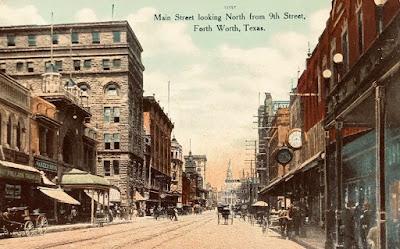
 
Houdini chose Main Street for his demonstration because it was the first "paved" street in Fort Worth. A series of wooden blocks, or round stumps, has been recessed into the street to protect the hooves of horses from injury. To protect himself, he wore a thick quilted overall. A hood to shield his head gave him the appearance of an Eskimo. Eager volunteers, attracted to the scene by the gathering crowd, tied his hands behind his back. A length of rope from Ormer's motorcycle was then attached to Houdini. The starting signal was given and with one last apprehensive glance behind him, Ormer reluctantly gave the gas to his cycle. Moving ever so slowly at first and then assured that his "passenger" wasn't being hurt by the jouncing about, Ormer gradually increased speed. But before he could attain real momentum, and much to his relief, it was all over. Houdini was free from his bonds and then from the rope attached to the motorcycle. The publicity paid off. The rest of his stand in Fort Worth, Houdini played to a packed house.

It's a great story. I think my favorite part is learning Houdini wore white Spaulding track shorts as underwear. However, I've never been able to corroborate it. I cannot find any photos or a single newspaper account. It does appear in a several Houdini books (Cartlidge, Silverman, Kalush), but their source is the Locklear book, which, as far as I can tell, is the only source for this second Fort Worth street feat.

So did it really happen? Or is it a Texas-sized Houdini myth? Ormer looks like he knows, but he's not talking!

Ormer Locklear - the man who dragged Houdini?

Related:

Friday, June 26, 2020

Magic Collectors' Corner goes inside the Houdini Museum of New York

This Sunday, June 28, the Magic Collectors' Corner weekly ZOOM conference (#11) will again be Houdini-themed. The highlight will be a tour of the recently reopened Houdini Museum of New York by owner Roger Dreyer himself.

"I look forward to sharing the Houdini Museum of New York with you all this Sunday. Not just Houdini, but Copperfield, Blackstone, Henning, and even a rubber chicken!" -Roger Dreyer

Magic Collectors' Corner Live Event #11
Meeting ID: 869 8962 9592
Password: Dante

IMPORTANT NOTE: The ZOOM event is limited to the first 100 participants, but a LIVE simulcast can be viewed on the Magic Collectors Corner Facebook Group. Join it now so you'll be assured you can watch the program.

Related:

Thursday, June 25, 2020

Locking down Houdini in Kansas

Don Creekmore, a lifelong resident of Kansas with a particular interest in the history of the Wichita area, is writing a book about Houdini in the Sunflower State. Don has launched a very well done website showcasing his research and asking for help in locating Houdini in Kansas. I love specialized work like this, and Don's site has me dazzled, especially all the new info he's uncovered on the California Concert Company. Have a look:

"Like many youngsters, Harry Houdini was almost a mythical figure in magic and history to me. How could someone bigger than life have any notable connection to Kansas? As my interest in his life, feats and mythology grew I stumbled upon a piece of faded fragile paper that would set in motion my desire to learn about Houdini's connection to the state & people of Kansas. As fate would have it, I would get married to my high school sweetheart in the Wichita Orpheum theater where Houdini performed in 1923.

So what was the faded piece of paper that started everything? As they say, you will have to wait for the book....."  -Don Creekmore

Related:

Tuesday, June 23, 2020

Houdini in 1907


The year 1907 saw Houdini touring free of his handcuff act and image. Exotic challenges now replaced the cuffs and spectacular bridge jumps supplanted jail breaks as his new headline grabbing stunt. It was a year in which he raised his profile and his price and became an undisputed star of American vaudeville, which in itself was booming under a new monopoly that embraced him.

This post is now retired. But you will be able to enjoy the story of Houdini in 1907 in my upcoming book

Monday, June 22, 2020

HOUDINI on The Jewish Lives Podcast

The Jewish Lives Podcast is a monthly show hosted by Stanford Storytelling Project veteran Alessandra Wollner. Each episode includes an interview with an acclaimed Jewish Lives author, in this case Adam Begley, author of Houdini: The Elusive American.


On August 12th Adam Begley will be in conversation with Rabbi Elliot Cosgrove as part of the Jewish Lives Summer with Park Avenue Synagogue series. You can get more information and register HERE.

You can purchase Houdini: The Elusive American at Amazon.com and Amazon.co.uk.

Related:

Sunday, June 21, 2020

Mystifier, Fall 2002

Continuing my issue by issue look back at the Mystifier, the newsletter of the Houdini Historical Center that ran from 1991-2003.


The Fall 2002 Mystifier celebrates the coming of the U.S. Postal Service's First Class Houdini stamp. This was a personal triumph for the HHC and Sidney Radner who had lobbied long and hard for this recognition. The newsletter contains photos and a report from the HHCs own dedication ceremony on July 5. For the occasion, Wisconsin-based escape artist Mike Schroeder performed a suspended straitjacket escape.

The newsletter continues with news of a second big event; the unveiling of John Gaughan's restored Water Torture Cell. The cell was displayed at the Center for Jewish History in New York from July 3 to August 5. The newsletter includes a photo of John with the USD, which for many was probably their first look at the restoration. It also has a Q&A with John. Below is a sampling:

Mystifier: Did you understand the mechanism in the Water Torture Cell before you began?
JG: I had reworked the Water Torture Cell in 1991. If I had not had that opportunity, it would have been impossible to restore the Water Torture Cell at all. I needed to be familiar with the whole piece since it was so totally destroyed in the fire. There were only fragments remaining of the original piece. 
Mystifier: What was the most difficult part of the project? 
JG: To be faithful to the original design. Not to cut corners but to use exact materials and methods of the original. The restoration used rare Honduras mahogany with a ribbon pattern, just as in the original. I used lap joints in the construction, as in the original to allow for the expansion and contraction that would occur when it was filled with water.

The newsletter continues with the sad news of the death of Ronald J. Hilgert, HHC member and author of Houdini Comes to America (1996). The museum shop announces new items related to the Houdini stamp, such a first day covers and pins. Recent donors are listed along with the staff of the HHC, which we now see is headed by Executive Director Terry Bergen who will prove controversial.

In his regular "Backstage" column, Sid (sporting a new column photo) talks about the HHC stamp event and the restored Water Torture Cell. He expresses disappointment that he was not invited to the official unveiling of the stamp in New York City. That ceremony featured David Copperfield (in a suit matching the one we see Houdini wearing in the stamp image) and Marie Blood. But Sid deems the Appleton ceremony as being the "much more impressive stamp dedication" and points out that it was covered by four TV stations.

Finally, it's worth pointing out that this issue introduces a few stylistic changes. No longer are the Contents listed on the cover. The font size is also increased (actually, the font sizes and styles are wildly inconsistent). This would also prove to be the last Mystifier printed in two colors.

Mystifier
Volume 12, Number 3
Fall 2002
6 pages

Contents:
U.S, Postal Service Recognizes Houdini!
The Water Torture Cell is Reborn!
R.I.P. Ronald J. Hilgert
Museum Shop News
Backstage with Sid Radner


Related:

Saturday, June 20, 2020

Houdini Comes Alive June 25

David London in conjunction with the Jewish museums of Maryland and Milwaukee will present a special Live Stream of his popular Houdini talk and performance on June 25.

JMM Squared - Houdini Comes Alive

On Thursday, June 25th at 7:30 pm EST the Jewish Museum of Maryland in partnership with Jewish Museum Milwaukee presents 'Houdini Comes Alive.' Join us for this magical performance with magician David London as he takes us back in time to truly discover the world's first superstar.

JMMSquared: The Jewish Museum of Maryland and the Jewish Museum of Milwaukee come together to present a unique pairing of programs, only made possible by our current challenging situation. This pair of programs celebrates the ways in which we have been able to successfully work together to bring to both Baltimore and Milwaukee some of our most popular exhibits of recent years including Inescapable: The Life and Legacy of Harry Houdini and Stitching History from the Holocaust.

Click here for more information and to register.

Related:

Friday, June 19, 2020

Climb aboard the Frisia

Here's a cutaway model of the German steamship SS Frisia that resides in the Smithsonian. What's this have to do with Houdini? Well, it was the Frisia that the Weiss family boarded in Hamburg 142 years ago today bound for America. It was the first ocean voyage for the 4-year-old Ehrich Weiss.


Built in 1872 by Caird & Co. in Scotland, the Frisia (originally launched as the Alsatia) was part of the Hamburg-American Line. It had room for 820 passengers and could make the Atlantic crossing in about 12 days. Frisia was one of the last iron steamships of its era. Following its run as an immigrant ship, Frisia was sold to Italian owners who converted it into a coal carrier. In 1902, the ship, then known as the Arno, was scrapped in Italy.


You can see many more photos of the SS Frisia model at the Smithsonian's American History website.

For more information about the Weiss family immigration check out Houdini Comes To America by Ronald J. Hilgert and Houdini: Escape into Legend, The Early Years: 1862–1900 by Manny Weltman.

Related:

Thursday, June 18, 2020

The Houdinis and the Doyles...take an Uber?

On this 98th anniversary of the infamous Atlantic City seance, here's a photo of Sir Arthur Conan Doyle, Lady Doyle, Bess and Houdini that I've not seen before. This was shared as the October 2015 "Treasure of the Month" at the Conan Doyle Collection website.

Click to enlarge.

I don't really know anything more about this image, other than it looks a little tight in that back seat. Someone can't sit up with the poor driver?

Soon I'll be sharing a "ghostly" Houdini-Doyle curiosity from the Fred Pittella collection. Stay tuned!

UPDATE: I'm going to make a guess that this is Denver, Colorado in May 1923. I believe the sign on the building behind them may read The Mile High Photo Co., which was a Denver business. At this time Houdini was performing at the Orpheum and Doyle was lecturing at the Ogden Theater.

Related:

Wednesday, June 17, 2020

LINK: TR vs. Houdini (History Vs. podcast)

This is a very well done telling of the famous story of Houdini fooling President Theodore Roosevelt aboard the Imperator in June 1914. Click the headline to have a listen at the History Vs. podcast at Mental Floss.


Related:

Translate